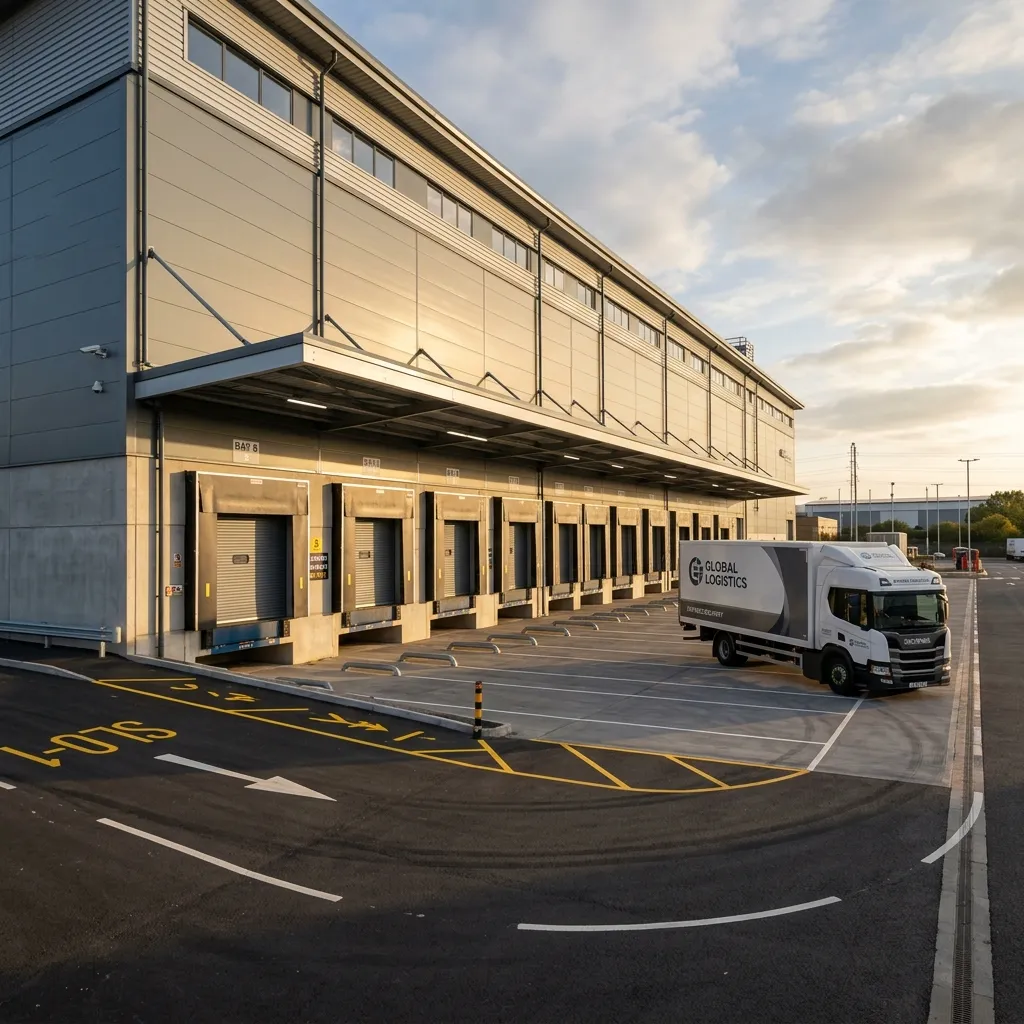
Rolling Shutters for Warehouses & Logistics — Complete Spec Guide
Table of Contents
A poorly specified rolling shutter in a warehouse context doesn't fail quietly. It fails at 2 AM when a truck is waiting, or during a monsoon when wind load exceeds what a standard domestic shutter was designed to handle. This guide gives warehouse and logistics procurement teams the exact parameters they need to specify correctly — first time.
Why Specification Matters for Warehouses
Residential and commercial rolling shutters are designed for 8–15 openings and closings per day. A busy warehouse loading bay sees 40–120 cycles daily. Over ten years, that is 150,000–440,000 cycles — far beyond what a standard shutter is rated for.
Undersizing a warehouse shutter creates three failure modes: mechanical failure of the spring system (springs fatigue before rated life), motor burnout (undersized motor overheating on repeated cycles), and curtain distortion (inadequate gauge sheet deforming under wind pressure or forklift brush-contact).
Rule of thumb: For any opening seeing more than 25 cycles per day, specify a unit rated for minimum 100,000 cycles. For high-frequency applications (cold chain, e-commerce fulfilment), specify 200,000+ cycles or a high-speed door.
Opening Types & Dimensions
Warehouse openings fall into four categories, each with different specification requirements.
| Opening Type | Typical Width | Typical Height | Recommended Shutter |
|---|---|---|---|
| Pedestrian access | 1,500–2,200mm | 2,100–2,500mm | Aluminium or GI motorised |
| Small vehicle / forklift | 3,000–4,500mm | 3,500–4,500mm | GI or galvalume, motorised |
| Standard truck dock | 4,000–5,000mm | 4,500–5,500mm | Galvalume or high-speed door |
| High-clearance / container | 5,000–8,000mm | 5,500–7,500mm | Heavy-gauge galvalume, twin motor |
For openings above 6,000mm width, a twin-motor configuration is mandatory — single motors cannot evenly distribute torque across a wide curtain without causing guide rail binding and premature spring wear.
Material Selection
Galvalume (Z275 coated steel)
The industry standard for warehouse applications. Z275 galvalume provides 40–60 years of corrosion resistance in standard industrial environments. At 0.8mm thickness with a 77mm C-profile curtain, it handles the wind loads and forklift proximity common in logistics facilities. Cost-effective for large bay counts.
Aluminium
Lighter than steel, corrosion-resistant without coating, and aesthetically cleaner. Preferred for distribution centres with temperature-controlled zones (lower thermal mass reduces condensation risk at the door seal), automotive showrooms adjacent to warehouses, and any application where curtain weight is a motor-sizing constraint.
High-Speed PVC Fabric
For high-cycle dock doors (100+ cycles/day), a fabric high-speed door outperforms steel shutters on cycle life, air infiltration, and speed. Opening speeds of 1.5–2.5 m/s vs 0.15–0.25 m/s for a motorised rolling shutter — critical for cold chain and clean room environments.
GRS Galvalume Warehouse Spec — Standard
- Curtain material 0.8mm Z275 galvalume steel
- Profile 77mm C-profile with foam-filled aluminium bottom bar
- Spring system Galvanised torsion spring, rated 100,000 cycles
- Max single-motor width 6,500mm
- Wind load rating 100 km/h standard; 120 km/h with wind bar kit
- Guide rail depth 75mm for spans >5,000mm
- Motor options FAAC / Somfy / Nice (customer selection)
- Finish Factory powder coat RAL or bare galvalume
Fire Ratings
Indian building codes under NBC 2016 require fire-rated doors/shutters at specific locations in warehouses, including: openings between a warehouse and an office block, stairwell enclosures, openings between high-rack storage zones and dispatch areas, and exit corridors.
| Location | Minimum Fire Rating | Shutter Type |
|---|---|---|
| Warehouse–office interface | 60 min (1-hour) | Insulated fire-rated rolling shutter |
| Stairwell / means of escape | 120 min (2-hour) | Fire-rated roller shutter with auto-drop |
| High-rack to dispatch zone | 60 min | Fire-rated shutter with fusible link |
| Electrical substation | 120 min | Fire-rated steel door or shutter |
Key specification point: Fire-rated rolling shutters use a fusible link mechanism that allows the shutter to auto-drop under gravity when the link melts at 72°C. The motor must be specified with a separate release mechanism — the fusible link disconnects motor drive during a fire event. Always specify this separately from standard motorised shutters.
Motor & Automation
Motor sizing is driven by three inputs: curtain weight (kg/m² × opening area), spring pre-tension loss at end of spring life, and duty cycle (cycles per day / hour).
| Opening Width × Height | Curtain Weight (approx) | Minimum Motor Torque | Duty Cycle Rating Needed |
|---|---|---|---|
| 3,000 × 3,500mm | ~62 kg | 100 Nm | Standard (40 cycles/day) |
| 4,500 × 4,500mm | ~145 kg | 200 Nm | Heavy-duty (80 cycles/day) |
| 6,000 × 5,000mm | ~230 kg | 2× 200 Nm (twin) | Heavy-duty (80 cycles/day) |
| 8,000 × 5,500mm | ~340 kg | 2× 300 Nm (twin) | Industrial (120 cycles/day) |
For integration with warehouse management systems (WMS) or building management systems (BMS), motors should support 24VDC control inputs and dry-contact triggers. Most FAAC, Somfy, and Nice commercial motors support RS485 or Modbus RTU — confirm with your BMS integrator before ordering.
"A motor specified at 100% of required torque will burn out in 18–24 months under heavy-duty warehouse use. Specify at 150% minimum."
High-Speed Doors for Warehouses
When daily cycles exceed 60–80 per bay, a high-speed door becomes the financially correct choice. The premium over a standard motorised shutter (typically 2.5–4× the capital cost) is recovered through: reduced HVAC losses (each second the door is open costs energy in temperature-controlled facilities), reduced motor replacement frequency, and faster throughput (trucks / forklifts wait less).
| Criterion | Standard Motorised Shutter | High-Speed Door |
|---|---|---|
| Opening speed | 0.15–0.25 m/s | 1.5–2.5 m/s |
| Rated cycle life | 50,000–100,000 | 200,000–500,000 |
| Air infiltration | High (no seal) | Low (brush/inflatable seals) |
| Wind load | 100–120 km/h | 60–80 km/h (fabric doors) |
| Safety (impact reset) | Limit switch only | Auto-reset after impact |
| Recommended threshold | <40 cycles/day | >60 cycles/day |
Dock Equipment
Rolling shutters at truck docks function as part of a dock system — the shutter alone does not determine facility efficiency. Key dock equipment to specify alongside shutters:
- Dock levellers: Mechanical (6-tonne, 8-tonne) or hydraulic (up to 12-tonne) — bridge the gap between dock floor and truck bed. Critical for safe forklift transfer.
- Dock shelters/seals: Prevent air infiltration and rain entry when a truck is backed up to the dock. Foam or inflatable types depending on truck fleet size variation.
- Wheel chocks and truck restraints: Prevent truck from pulling away during loading. Electric/mechanical restraint hooks are best practice for busy docks.
- Traffic lights (dock signalling): Red/green light systems on the dock face (exterior) and bay interior to coordinate safe truck positioning and shutter operation.
Integration note: Modern dock management systems can interlock the shutter motor with the dock leveller — the shutter can only open once the leveller is in position, and the leveller cannot deploy until the shutter confirms full-open. This prevents accidents in multi-bay facilities.
Warehouse Procurement Checklist
Use this checklist when issuing a Request for Quotation (RFQ) for warehouse rolling shutters:
- Confirm clear opening width and height (not rough opening) for each bay
- Specify expected daily cycles per bay
- Confirm available headroom above lintel for drum and motor
- Specify required wind load (based on site location and exposure category per IS 875)
- Confirm whether fire-rated shutters are required (check with structural engineer / fire consultant)
- Specify motor brand preference or BMS integration requirements
- Confirm power supply availability at each bay (single-phase or three-phase)
- Specify finish (galvalume as-is, primer + paint, powder coat — with RAL colour if applicable)
- Confirm whether dock levellers and dock seals are in scope
- Request a written warranty document (not just a verbal promise)