Industrial Rolling Shutters for Warehouses: A Technical Guide
Table of Contents
Retail shutter selection is relatively forgiving — a few key decisions determine a specification that will last decades. Warehouse and industrial shutter selection is not. The variables multiply: span widths, curtain weights, motor loads, wind exposure, vehicle clearance heights, and cycle counts all interact. Getting any one of them wrong creates recurring costs that dwarf the initial saving.
This guide covers the critical specification decisions for industrial rolling shutters in warehouses, factories, and distribution facilities.
Opening Dimensions and Clear Height
Industrial bays must accommodate the vehicles that use them. Standard vehicle height requirements:
- Rigid body trucks (9-tonne): 4,200mm clear height minimum
- Full-size container trailers: 4,800mm clear height minimum
- Refrigerated trailers: 5,200mm minimum (higher roof profile)
- Low-loader flatbeds with tall cargo: Confirm per load — may require 5,500mm+
Width: a single-trailer bay should be at minimum 4,200mm clear. For two-way pedestrian clearance alongside a parked trailer, 5,000mm+ is appropriate.
Common mistake: Specifying clear height based on truck dimensions alone without accounting for the shutter hood box. A 4,800mm clear opening may require the bottom of the hood to be at 5,400mm — confirm structural slab height well before ordering.
Why Galvalume Is the Industrial Standard
For most warehouse and industrial applications, galvalume steel (aluminium-zinc alloy coated steel) is the correct material specification. Here is why it outperforms the alternatives at industrial scale:
- Cost-per-sq-ft: For spans above 5,000mm, galvalume is 25–40% less expensive than aluminium per square metre of curtain area
- Strength-to-weight: Galvalume at 0.8mm provides equivalent or better structural rigidity to aluminium at 1.0mm, reducing spring and motor loads while maintaining curtain integrity
- Corrosion resistance: Galvalume's zinc-aluminium coating is galvanic — it self-heals at cut edges. GI steel requires paint for corrosion protection; aluminium does not rust but does corrode at galvanic contact points
- Wide-span performance: For openings above 7,000mm width, galvalume curtains with intermediate stiffener slats are standard specification — maintaining curtain flatness under wind and temperature variation
Motor Sizing for Industrial Applications
This is the most commonly under-specified element on industrial projects. The motor rating must account for:
- Curtain weight (kg/m² × total area)
- Spring assist efficiency (typically 85–90% — springs do not fully offset curtain weight)
- Starting torque requirement (typically 2× running torque)
- Duty cycle (cycles per hour — industrial use may demand 15–25 cycles/hour during peak periods)
Standard sizing guide for galvalume curtains:
| Opening Size (W × H) | Curtain Weight (approx.) | Minimum Motor Rating |
|---|---|---|
| Up to 3,500 × 3,500mm | 40–65 kg | 300 kg rated |
| Up to 5,000 × 4,500mm | 80–130 kg | 500 kg rated |
| Up to 7,000 × 5,000mm | 130–220 kg | 750 kg rated |
| Over 7,000mm wide | 220 kg+ | 1,000 kg rated or dual motor |
Under-sizing the motor: A motor running above 80% of rated load on every cycle will fail in 18–36 months. We always specify motor rating with a minimum 25% headroom above calculated load.
Wind Load for Exposed Industrial Locations
Open industrial parks, logistics corridors, and highway-adjacent warehouses experience significantly higher wind loads than urban retail locations. A shutter that performs adequately in a sheltered urban location may deflect, rattle, or fail structurally in an exposed industrial park during strong winds.
For exposed locations or openings above 5,000mm wide, specify:
- Intermediate wind bar (centre-mounted horizontal bar that engages guide slots to resist wind-induced curtain deflection)
- Deeper side guide engagement — 75mm+ depth vs standard 50mm
- Reinforced bottom bar with wind locks that engage both side guides
- For very exposed locations (>120 km/h design wind speed): structural engineering sign-off on curtain and guide fixings into the building frame
Dock Bay Positioning and Floor-Level Considerations
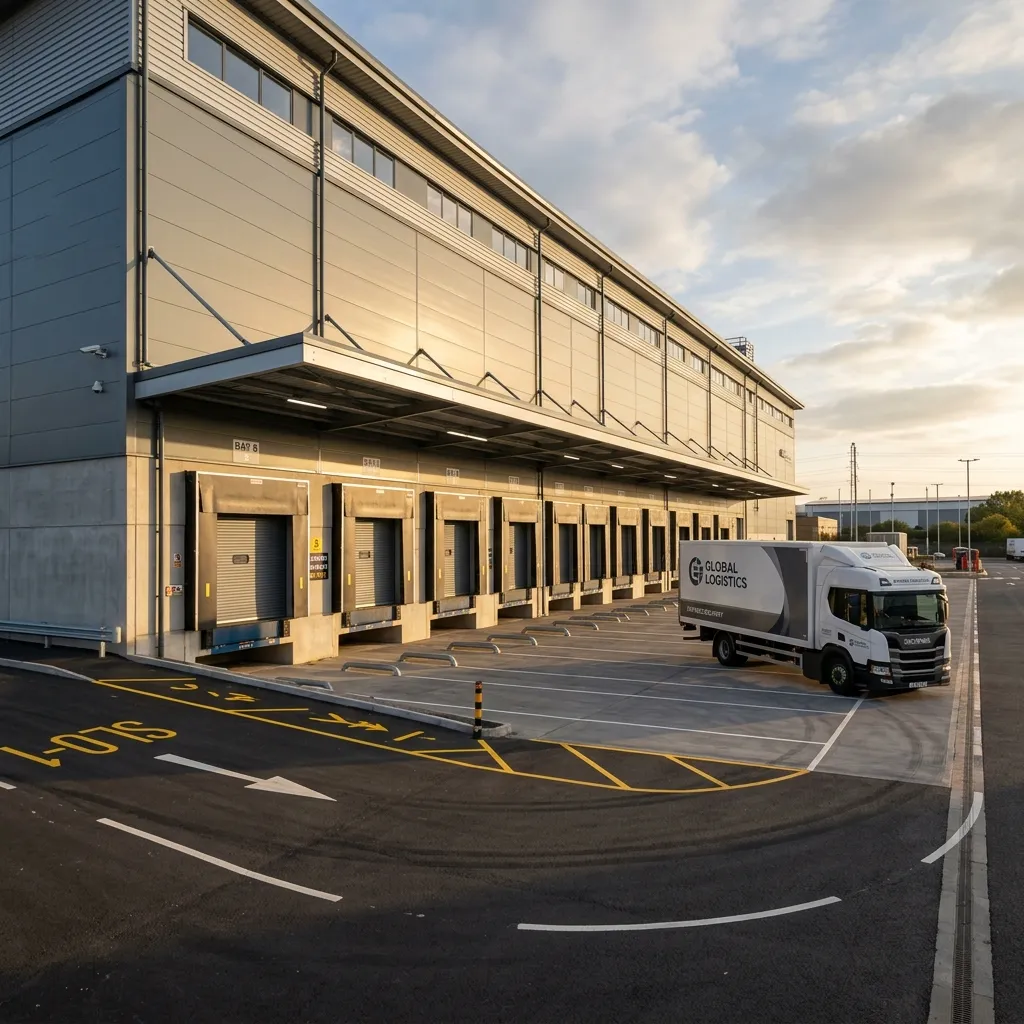
Loading dock shutters have a specific challenge that standard installations do not: the floor level at the shutter opening is often different inside and outside. Raised dock platforms (typically 1,200mm above driveway level) mean the shutter has an irregular floor profile. Standard solutions:
- Dock shelter systems: The shutter operates at the top of the dock wall; a dock shelter seal around the trailer nose provides weather sealing
- Full-height shutter with bottom seal: Shutter spans from driveway level to overhead, with a flexible bottom seal that closes against both dock apron and driveway surfaces
- Two-shutter configuration: An outer driveway-level shutter for weather and security; an inner dock-height shutter for operational use
When to Specify High-Speed Doors for Internal Zones
For internal zone separation within a warehouse — between temperature-controlled and ambient zones, between dusty processing areas and clean storage, or between heavily trafficked forklift aisles and pedestrian corridors — a high-speed door is often the correct specification rather than a rolling shutter. See our separate guide on high-speed doors vs rolling shutters for the decision criteria.
Heavy-Duty Bottom Bars for Forklift Environments
Standard bottom profiles are not rated for contact with forklift tines. In any facility where forklifts operate near shutter openings, specify:
- 100mm × 50mm box section steel bottom bar (vs standard 65mm × 25mm)
- Forklift protection bollards or barrier rails flanking the shutter opening
- High-visibility yellow and black striping on the bottom bar (reduces incidents)
- Sacrificial bottom seal that can be replaced without replacing the entire bar
"Under-specification creates recurring costs. Industrial projects have more variables than retail."
Typical Industrial Specification: Distribution Warehouse Bay
Reference Specification — 6m × 5m Loading Dock Bay
- Material Galvalume steel, 0.8mm Z275 coating
- Slat profile 77mm C-profile with intermediate stiffeners at 1,800mm and 3,600mm height
- Guides 75mm deep side guides, anchor-bolted into structural RCC pilaster at 600mm centres
- Bottom bar 100×50mm box section with forklift protection angle, dual-lock into both guides
- Wind bar One intermediate wind bar at mid-height engaging guide slots
- Motor 750 kg rated tubular motor, 3-phase, IP44, with manual override
- Controls Wall push-button inside + outside, loop detector in driveway, remote handset for duty manager
- Hood box Fabricated steel, rain deflector angle on front face