5 Signs Your Rolling Shutter Needs Repair Now
Table of Contents
Rolling shutters rarely fail without warning. There are almost always early signs — usually weeks or months before a complete breakdown. Catching and addressing these signs costs a fraction of emergency repair. Here are the five most important ones to watch for.
The Shutter Feels Noticeably Heavier
A properly tensioned spring should make the shutter feel almost weightless — you should be able to lift it with one hand. If you are now using two hands, bending your knees to pull it up, or needing a second person to assist, the spring has lost tension. This happens gradually over time and is often not noticed until it becomes a significant problem.
Left unaddressed, a weak spring causes every other component to wear faster: the curtain puts more stress on the guides, the bottom bar absorbs harder impacts at closing, and for motorised shutters, the motor is working under excessive load — shortening its life significantly.
Fix: Spring retensioning or replacement. Requires professional inspection and tuning
New Grinding, Scraping, or Squealing Noises
A well-maintained shutter should operate with only a light mechanical hum. New sounds indicate contact where there should be none. Common causes:
- Grinding: Debris inside the side guide channel, or curtain slats physically contacting the guide walls due to misalignment
- Scraping: Bottom profile dragging on an uneven floor, or a bent slat rubbing against the adjacent slat
- Squealing: Dry bearings in the spring shaft brackets or guide wheel assemblies — usually resolved with lubrication
Fix: Cleaning and lubrication first. If noise persists, a technician visit to identify physical damage to curtain, guides, or bearing assemblies.
Shutter Stops or Sticks at the Same Point
If your shutter consistently stops, hesitates, or requires extra force at a specific height, there is a localised obstruction or damage at that point. For motorised shutters, the motor's obstacle detection may trigger at the same intermediate point, reversing the shutter as if something blocked it.
Common causes: a bent slat that creates a wider profile at one point, a dent in the side guide channel, debris that has compacted at a specific location, or a misaligned bearing that binds at a certain drum rotation.
Fix: Identify and address the specific cause. A bent slat can sometimes be straightened; a dented guide section may need replacement. Do not repeatedly force the shutter past a sticking point — this accelerates damage.
Motor Runs But the Shutter Doesn't Move (or Moves Slowly)
You hear the motor running, but the curtain moves sluggishly or not at all. This typically indicates one of:
- Slipped gearbox: The motor's internal coupling has failed — motor shaft turns but does not transmit to the drum
- Spring failure: A broken spring means the motor has to lift the full curtain weight — it stalls under load even though it is trying to run
- Overload trip: Motor thermal protection has tripped due to repeated heavy use. Wait 20 minutes, then retry. If it trips again, the underlying load problem needs addressing.
Fix: Do not continue to run the motor if the shutter is not moving. You risk burning out the motor windings, turning a ₹2,000 gearbox repair into a ₹6,000–₹12,000 motor replacement.
Bottom Bar Is Bent, Twisted, or Misaligned
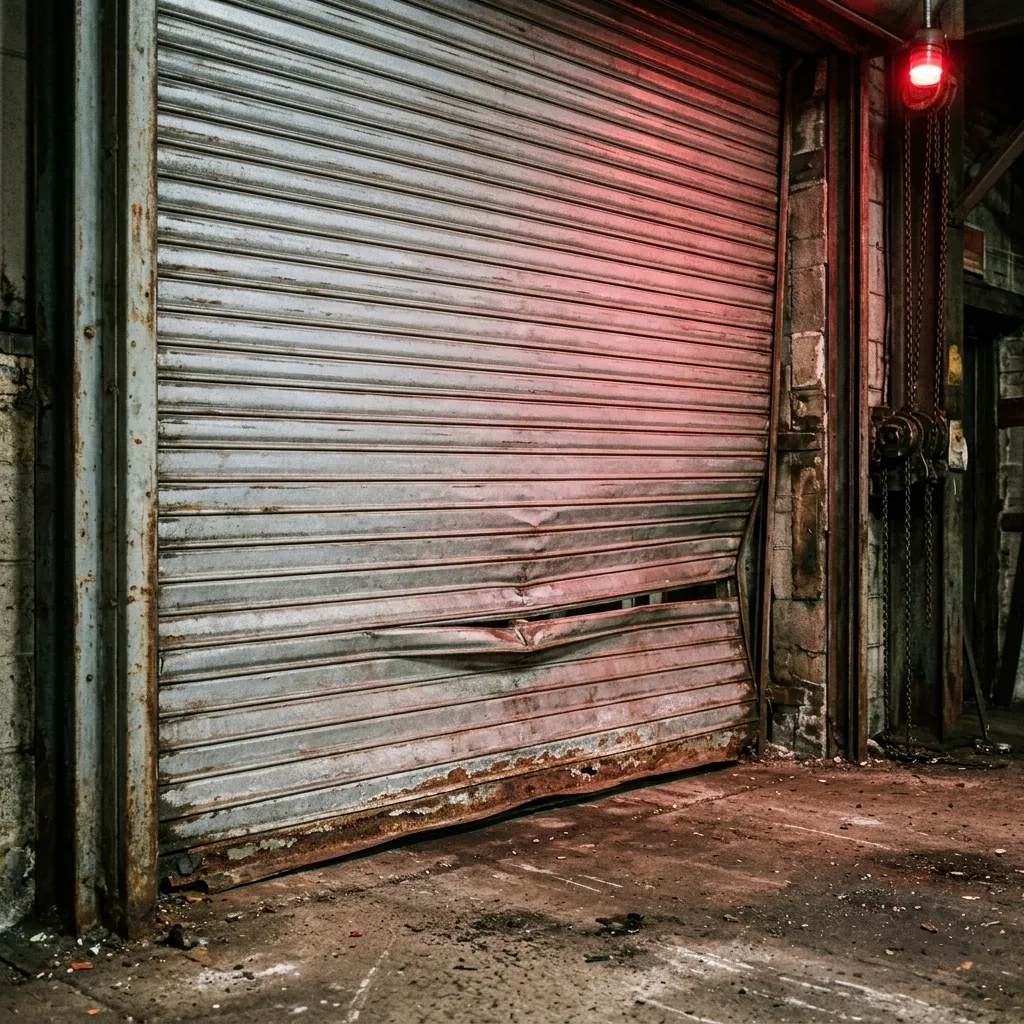
The bottom profile should be perfectly horizontal and straight along its full length when the shutter is closed. If it is bowing, twisted at one end, or has visible bends, it means the bar has taken an impact (vehicle, forced entry attempt, or repeated hard closings on an uneven floor) or the side guides have shifted out of plumb.
A bent bottom bar prevents the shutter from seating correctly on the floor, creating a gap that compromises security and weather protection. It also causes the curtain to bind in the guides at the bottom of each close cycle.
Fix: Bottom bar replacement and guide realignment. This is a straightforward repair — typically completed in 1–2 hours.
Emergency situation: If your shutter jams in the closed position during business hours — do not force it open with a lever or vehicle. This can cause the spring shaft to fail suddenly, dropping the full weight of the curtain. Call us immediately — we offer prompt emergency repair services at +91 99712 49043.
"Rolling shutters rarely fail without warning. Catching problems early costs a fraction of what emergency repair or full replacement does."
Annual Maintenance Prevents All of These
All five of the signs above are preventable with an annual maintenance visit. Spring tension is checked and corrected before it becomes a problem. Guides are cleaned and lubricated so debris never builds up. Motor load is assessed before damage occurs.
Our Annual Maintenance Contract (AMC) covers two visits per year at ₹1,800–₹3,200 depending on shutter type. On average, customers on our AMC programme report zero emergency call-outs compared to 1–2 per year for non-maintained shutters. The maths are simple.